The MAGE Project: Size Evolution and Disk Formation in Massive Galaxies at Cosmic Dawn

The MAGE Project: Size Evolution and Disk Formation in Massive Galaxies at Cosmic Dawn
Zhiyuan Yao, Avishai Dekel, Romain Teyssier, Rachel Somerville, Nir Mandelker, Zachary Andalman, Ulrich Steinwandel, Zhaozhou Li
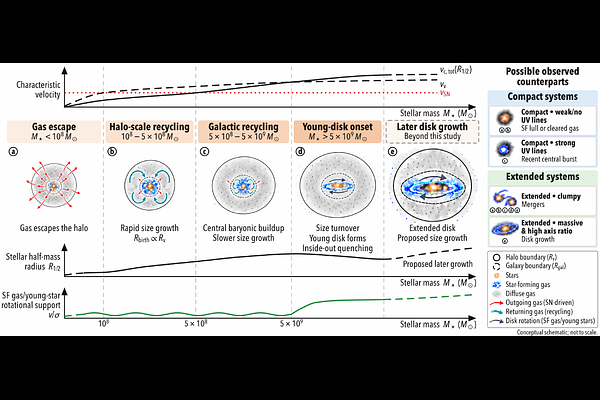
AbstractWe investigate size evolution and disk formation with a new suite of eleven cosmological zoom-in simulations, Massive Assembly of Galaxies in the Early universe (MAGE), run with RAMSES at $\sim10\,\mathrm{pc}$ resolution until $z\simeq9$. The target galaxies span stellar masses of $M_\star\simeq2\times10^8$-$3\times10^{10}\,M_\odot$ at $z=9$. The stellar half-mass radius grows steeply with stellar mass at low masses, turns over near $M_\star\simeq5\times10^9\,M_\odot$, and evolves weakly with redshift. The intrinsic UV sizes in MAGE overlap the compact end of observed distributions, including the compact strong-line systems, but not the more extended population at $z>9$. Dust, PSF-limited size measurements, and our overdense environments may contribute to this offset. In the simulations, stars dominate the mass within the half-mass radius above $M_\star\simeq5\times10^8\,M_\odot$, where the central circular speed exceeds a characteristic stellar-feedback scale. Outflows are then increasingly retained within the galaxy, consistent with gas recycling on galactic rather than halo scales, which sustains central gas supply and drives a compaction-like central buildup. The turnover in size at $M_\star\simeq5\times10^9\,M_\odot$ coincides with rapid growth of rotational support to $v/σ\simeq1.5$-$3$ in star-forming gas and stars younger than 10Myr, as the central circular speed exceeds the halo virial speed, which the star-forming gas velocity dispersion tracks. The subsequent low central gas fraction, declining central star formation, and younger outskirts suggest the onset of inside-out quenching.