Outflows in the Early Universe: Neutral gas Absorption in Galaxies at z > 3 from low-resolution JWST Spectroscopy

Outflows in the Early Universe: Neutral gas Absorption in Galaxies at z > 3 from low-resolution JWST Spectroscopy
Matteo Sapori, Sirio Belli, Letizia Bugiani, Amir H. Khoram, Caterina Liboni, Gabriel Maheson, Gabriel Brammer, Rebecca Davies, Pratika Dayal, Anna de Graaff, Joel Leja, Rohan Naidu, Pascal Oesch, Stefano Sotira, Sandro Tacchella, Bingjie Wang, Katherine E. Whitaker
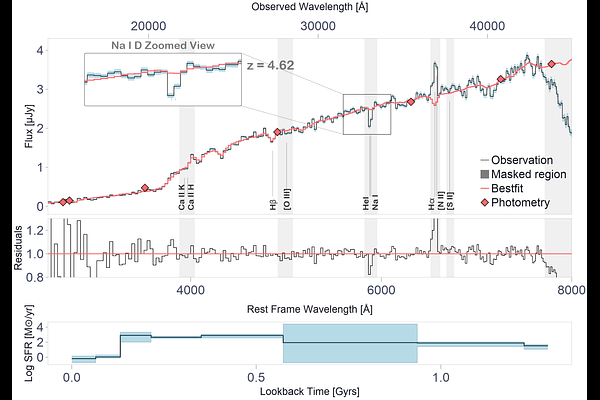
AbstractRecent JWST/NIRSpec observations have shown that Na I D absorption tracing neutral gas outflows is widespread in massive galaxies at Cosmic Noon ($z\sim2$-$3$), but their prevalence at higher redshift remains largely unexplored. Here we investigate whether similar outflows are already in place during the first 2 Gyr of cosmic history ($z>3$), using a sample of 811 galaxies at $3<z<7$ from the public DAWN JWST Archive and the Mirage or Miracle survey, with secure spectroscopic redshifts and continuum SNR$>5$ in their JWST/NIRSpec PRISM low-resolution spectra ($R\sim100$). We derived physical properties and star formation histories via Prospector SED fitting and isolated the Na I D feature in each spectrum by subtracting the best-fit stellar continuum. We detect an excess of Na I D absorption in 20 galaxies, almost all at $3<z<5$ with stellar mass $>10^{10} M_\odot$, an overall detection fraction of $\sim2.5\%$. The detection fraction rises steeply with stellar mass and quiescence, reaching $\sim11\%$ among the most massive galaxies and $\sim43\%$ among massive quenched systems. The Na I D equivalent widths are large, spanning 4 to 16 Angstrom, and are highest in dusty star-forming galaxies. In previous medium-resolution observations, EWs above 5 Angstrom were mostly found in outflowing gas; we thus interpret our detections as mostly tracing neutral outflows, despite the lack of kinematic information at PRISM resolution. A stacking analysis confirms these trends and provides average Na I D EWs for different subsamples. Under conservative assumptions, we estimate mass outflow rates of 4 to 12 $M_\odot$ yr$^{-1}$, exceeding the current star formation rate for about 30% of the detected galaxies. We conclude that neutral outflows are likely already present and important in massive galaxies during the first 2 Gyr of cosmic history.