Beyond Linear Activation Steering: Invertible Latent Transformations for Controlling LLM Behavior

Beyond Linear Activation Steering: Invertible Latent Transformations for Controlling LLM Behavior
Tuc Nguyen, Thai Le
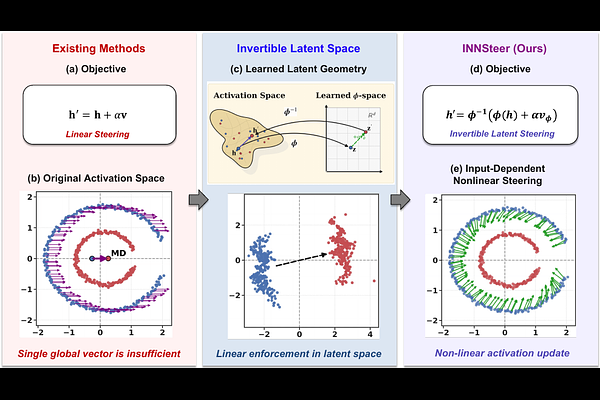
AbstractActivation steering provides a lightweight inference-time mechanism for controlling large language models (LLMs) by modifying their internal activation vectors toward desired behaviors. Most existing methods compute a fixed steering direction in the original activation space, typically from pairs of contrastive examples using mean differences, linear probes, or arbitrary separability criteria. While effective to a certain extent, these methods treat behavioral control as a global, linear, additive offset: the same direction is applied across inputs, and behaviors are linearly separable. This can be restrictive when behavioral features vary nonlinearly across the activation space or lie on curved and anisotropic manifolds, where the optimal intervention may be input-dependent. To address this limitation, we propose INNSteer, a nonlinear activation steering framework based on invertible latent transformations. Rather than searching for a better steering vector in the original representation space, INNSteer learns a lightweight invertible neural network $φ$ that maps an LLM's activations into a latent space where behavioral classes are more amenable to linear control. At inference time, activations are mapped through $φ$, steered in the latent space, and mapped back through the exact inverse transformation $φ^{-1}$. This makes a simple latent-space translation become a nonlinear, input-dependent intervention in the original activation space. Across experiment settings on multiple LLM families, scales, behavioral traits, and safety benchmarks, INNSteer consistently improves model control over linear, transport-based, and nonlinear steering baselines while largely preserving generation fluency.