SCOPE: A Syndrome-Driven Control Plane for QEC-Enabled Quantum Networks

SCOPE: A Syndrome-Driven Control Plane for QEC-Enabled Quantum Networks
Xiaojie Fan, Zian Wang, Ashutosh Tiwari, Himanshu Gupta
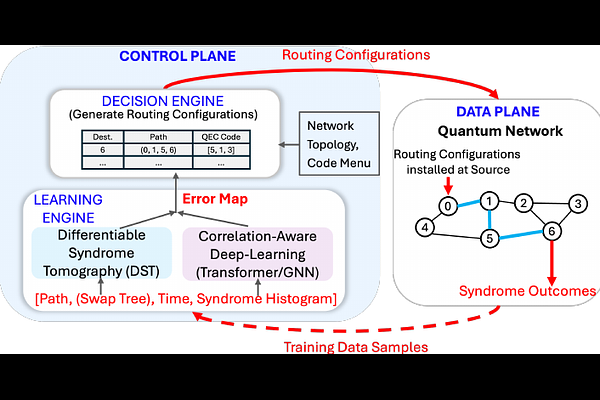
AbstractAs quantum networks evolve from experimental testbeds to fault-tolerant systems, the primary performance metric shifts from physical link fidelity to end-to-end logical error rate. However, current control planes remain ill-equipped for this transition: routing decisions are typically decoupled from Quantum Error Correction (QEC) strategies, relying on topology or scalar fidelity metrics that fail to predict how specific physical noise structures interact with logical codes. Optimizing this coupled route-and-code performance requires precise, real-time visibility into network error biases, yet traditional active tomography is operationally prohibitive due to throughput collapse and service interruption. We present SCOPE (Syndrome-based COntrol PlanE), a network-layer architecture that enables joint routing and coding optimization using purely passive telemetry. Instead of injecting probes, SCOPE harvests error syndromes -- the parity-check outcomes naturally generated by QEC decoders during user service. By aggregating these signals, SCOPE's inference engine reconstructs the network's time-varying error map, capturing complex, context-dependent noise correlations. This visibility drives a decision engine that proactively pushes optimal route-and-code configurations to source nodes. NetSquid and IBM-calibrated simulations show that SCOPE reduces estimation error by more than 60% relative to a standard EM baseline. In large-scale networks, this precision reduces logical error rates by 30-35% (up to 65%) against topology-aware baselines.