Comparative 3D Asymmetric Expansion and Angular Widths Evolution of Fast and Slow Coronal Mass Ejections

Comparative 3D Asymmetric Expansion and Angular Widths Evolution of Fast and Slow Coronal Mass Ejections
Anjali Agarwal, Wageesh Mishra, Jie Zhang, Soumyaranjan Khuntia, Manuela Temmer
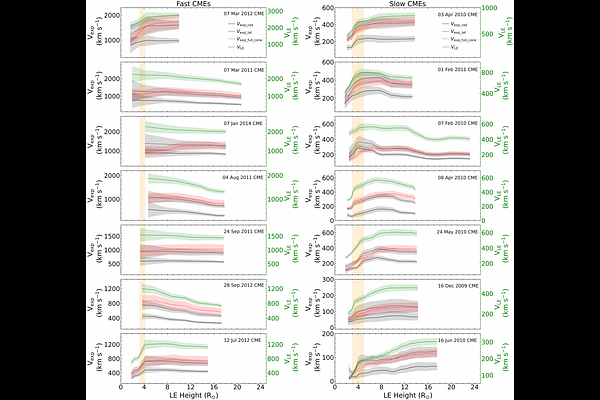
AbstractThe radial and lateral dimensions of coronal mass ejections (CMEs) influence their duration and probability of encounter at Earth. These properties are linked to the expansion speed of CMEs in different radial and lateral directions; however, most earlier studies modeled CME evolution using a projected full ice-cream cone geometry, which does not distinguish between radial and lateral expansion. Our study investigates the asymmetric expansion (relative radial and lateral components) and kinematics of seven fast and seven slow CMEs within coronagraphic heights, using the Graduated Cylindrical Shell model. Our study confirms that CMEs expand asymmetrically, with lateral expansion exceeding radial expansion in both CME populations. This asymmetry limits the accuracy of the full ice-cream cone model. For both fast and slow CMEs, higher leading edge speeds are associated with higher expansion speeds. At a height of 10 Rs, slow CMEs with larger expansion speeds (lateral and radial) have larger angular widths (face-on and edge-on), whereas fast CMEs exhibit a negative correlation between lateral expansion speed and face-on angular width. We find that the expansion and propagation speeds of slow CMEs exhibit a two-phase evolution, whereas those of fast CMEs display more diverse trends. Overall, this study suggests that fast and slow CMEs evolve differently and should not be treated as a single population in statistical estimates of their physical parameters. Our study highlights the importance of estimating CME angular widths and expansion speeds along different directions, and beyond standard coronagraphic heights, to capture their complete physical evolution.