Overmassive and Undermassive Massive Black Holes: The Role of Environment and Gravitational-Wave Recoils

Overmassive and Undermassive Massive Black Holes: The Role of Environment and Gravitational-Wave Recoils
David Izquierdo-Villalba
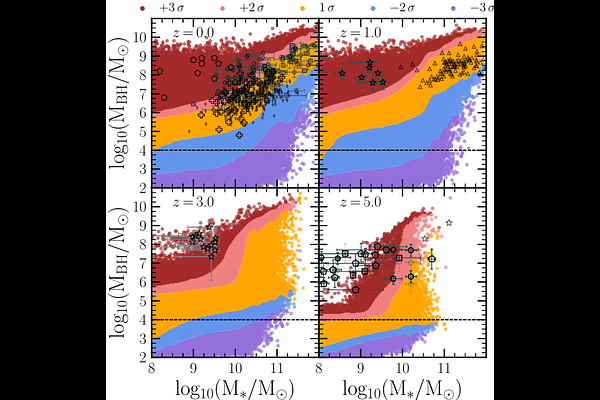
AbstractUnderstanding the connection between galaxy properties and their central massive black holes (MBHs) is key to unveiling their co-evolution. We use the ${\tt L{-}Galaxies{-} \it BH}$ semi-analytical model and the ${\tt Millennium}$ suite of simulations to investigate the physical origin of galaxies hosting overmassive and undermassive MBHs with respect to the $M_{\rm BH}-M_*$ relation, across stellar mass and cosmic time. We find that distinct evolutionary pathways drive different offsets from the scaling relation. Overmassive MBHs are primarily associated with galaxies that experienced enhanced merger history and secular activity. At $z\,{>}\,4$, this activity often leads to early, rapid MBH growth, frequently involving super-Eddington accretion episodes. At low redshift, a minority of overmassive systems ($20\%$) instead arise from environmental effects that reduce the stellar mass of the host, shifting galaxies above the relation without requiring additional MBH growth. Undermassive MBHs originate from two main channels. In massive galaxies, gravitational recoil following MBH mergers can eject the central MBH, temporarily leaving the galaxy without a nucleus. During this phase, MBHs coming from previous galaxy mergers can become the new central MBHs, but their masses remain below the expected ones from the scaling relation, as they never co-evolved with their new host galaxy. In low-mass galaxies ($M_*<10^9 M_\odot$), undermassive MBHs are more commonly linked to a quiescent evolutionary history, with limited mergers and weak secular processes that suppress an efficient MBH growth. We therefore conclude that outliers of the $M_{\rm BH}-M_*$ do not arise from a single mechanism, but from the interplay between environmental effects, gravitational recoils, and diverse MBH fueling histories, whose relative importance varies with galaxy mass and redshift.