Pushing the Classical Frontier of 1D Fermi-Hubbard Quench Dynamics Beyond Current Quantum Simulations

Pushing the Classical Frontier of 1D Fermi-Hubbard Quench Dynamics Beyond Current Quantum Simulations
Roman Rausch, Sukhbinder Singh, Saeed S. Jahromi, Augustine Kshetrimayum, Roman Orus
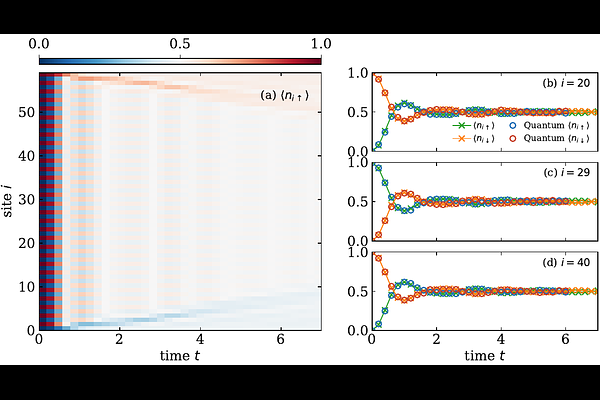
AbstractEstablishing quantum advantage requires comparison against the best achievable classical simulation. The Q-CTRL team recently simulated quench dynamics of the one-dimensional Fermi-Hubbard model on an IBM processor, completing a $L=60$ evolution to time $t=6$ in under three minutes and claiming a $3000\times$ speedup over classical Time-Dependent Variational Principle (TDVP) simulation at bond dimension $χ=4096$. Their classical benchmark required over 160 hours on a CPU cluster, failed to converge in the high-entanglement regime $t\in[5.2,6]$, and left the most challenging window of the experiment unverified. Here, we push the boundaries of classical simulation by exploiting the full $\mathrm{U}(1)\times\mathrm{SU}(2)$ symmetry of the Fermi-Hubbard Hamiltonian combined with GPU-accelerated tensor contractions. Reaching bond dimensions up to $χ\approx62{,}000$ on four NVIDIA H200 GPUs -- among the largest ever achieved in TDVP simulations and fifteen times larger than Q-CTRL's classical baseline -- we achieve fully converged results across the entire simulation window, including rigorous certification of the previously unresolved high-entanglement regime $t\in[5.2,6]$. We further advance the classical frontier to $t=7$, which lies beyond the quantum hardware experiment and any previously verified classical evolution of the full wavefunction. At the bond dimension comparable to Q-CTRL's best classical run, our GPU implementation completes in $\sim\!100$ minutes, directly reducing the claimed $3000\times$ quantum advantage to $\sim\!36\times$. These results substantially narrow the quantum-classical performance gap and establish a new standard for tensor-network benchmarking of large-scale quantum simulations.