Massive star formation at the Galactic crossroads: Insights from G358.69+0.03 in the Galactic center

Massive star formation at the Galactic crossroads: Insights from G358.69+0.03 in the Galactic center
A. Cheema, V. S. Veena, K. M. Menten, T. S. Pillai, S. A. Dzib, A. Brunthaler, S. Khan, R. Dokara, M. R. Rugel, Y. Gong
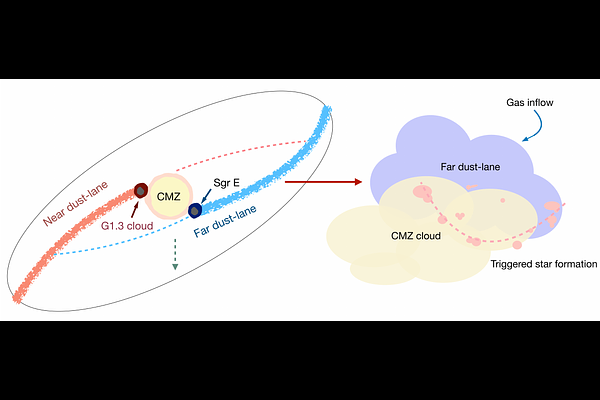
AbstractWe investigated the high-mass star formation activity in a subregion of the Sagittarius E star-forming complex, centered at (l,b) = (358.69 deg, 0.03 deg), where infrared and radio sources trace a prominent U-shaped structure that has not been identified in previous studies. We used radio continuum data from the Global View on Star Formation (GLOSTAR) survey, which is a wide-band radio (4-8 GHz) survey of the Milky Way that combines data from the Karl G. Jansky Very Large Array and the Effelsberg 100 m telescope. Using BLOBCAT source extraction software, we identified 49 compact radio sources. Based on multiwavelength associations and spectral index estimates, we identified GLOSTAR counterparts to 27 previously confirmed HII regions, detected radio emission from 3 WISE "radio-quiet" candidates, and report 5 new HII region candidates. The derived physical properties indicate that most are relatively evolved HII regions. We find around 50 cold dust clumps, predominantly toward the south and southeast. Mid-infrared flux-ratio maps ([4.5]/[3.6]) show localized shock enhancements along the arc and adjacent clumps, and 15 clumps exhibit SiO emission with broad components indicative of shocks. Together with CO data, the SiO velocity components delineate a continuous (>100 km/s) velocity bridge that links the far dust-lane inflow to the central molecular zone (CMZ) stream. The largest concentration of clumps and compact HII regions lies at this interface. These combined diagnostics favor a scenario in which bar-driven cloud-cloud collision at the far dust-lane-CMZ interface compressed the gas and triggered the observed high-mass star formation.