SPURS: Bursty Star Formation in an Extremely Luminous Weak Emission Line Galaxy at $z=9.3$

SPURS: Bursty Star Formation in an Extremely Luminous Weak Emission Line Galaxy at $z=9.3$
Zuyi Chen, Daniel P. Stark, Charlotte A. Mason, Adele Plat, Viola Gelli, Peter Senchyna, Keerthi Vasan G. C., Ryan Endsley, Mengtao Tang, Michael W. Topping, Lily Whitler
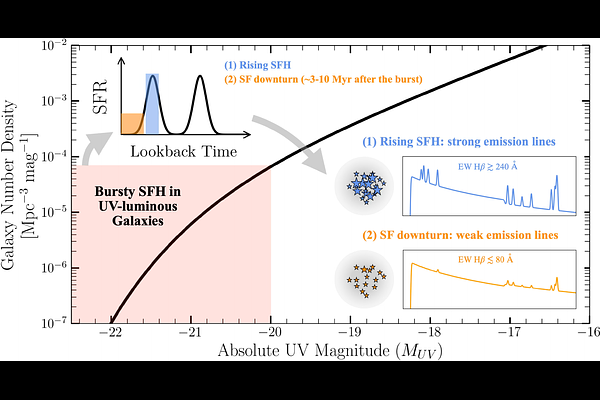
AbstractJWST has revealed a population of super-luminous early galaxies with a volume density in excess of most expectations. The spectra reveal diverse properties: while some reveal strong emission lines characteristic of galaxies in the midst of strong bursts, others show weak emission lines that could reflect old stellar populations, large escape fractions, or post-burst star formation histories. Through the JWST Cycle 4 large program SPURS, we have obtained ultra-deep (29 hr) rest-frame UV spectroscopy of a z=9.3 super-luminous ($M_{\rm UV}=-21.66$) galaxy with large assembled stellar mass (1.6$\times$10$^9$ $M_\odot$) and extremely weak emission lines (H$β$ EW $\approx25$~Å). The strong stellar wind features and rest-optical line ratios suggest the galaxy is already significantly enriched, with a metallicity of 0.4--0.7~Z$_\odot$. The interstellar absorption lines reveal outflows ($v\simeq -161$~km~s$^{-1}$) with a large neutral gas covering fraction, suggesting that the weak emission lines are not due to large escape fractions. The combination of the Balmer break, weak emission lines, and stellar wind features constrains the star formation history, indicating a recent burst of star formation lasting 10--20 Myr followed by a downturn over the last 10~Myr. The observations suggest that $z\gtrsim 9$ weak emission line galaxies such as this source can be explained by stochastic star formation, provided that the downturns in star formation are recent (i.e., <10 Myr prior to observation). The ultra-deep grating spectrum enables the IGM damping wing to be characterized, decoupling the effects of local absorption. The smooth Ly$α$ break indicates that this source, one of the most massive galaxies known at z>9, is likely situated in a small ionized bubble ($0.29_{-0.09}^{+0.11}$~pMpc), as is common at large neutral hydrogen fractions ($\bar{x}_{\rm HI}=0.81_{-0.21}^{+0.14}$).