Synthetic disk-integrated absorption lines isolating stellar granulation for high-precision RV studies

Synthetic disk-integrated absorption lines isolating stellar granulation for high-precision RV studies
Ginger Frame, Heather Cegla, Cis Lagae, Veronika Witzke, Christopher Watson, Sergiy Shelyag, Vatsal Panwar, Michael Palumbo, Alexander Shapiro
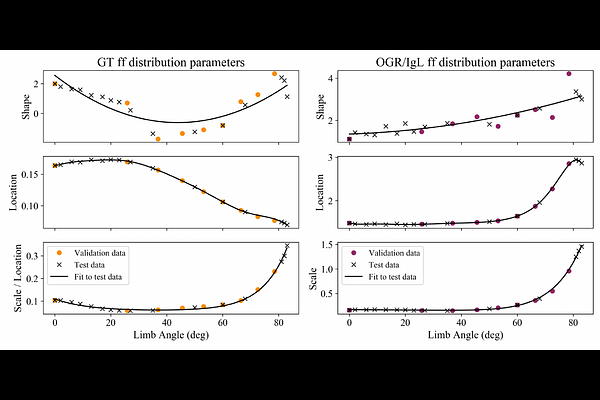
AbstractWe present a novel method for constructing high-accuracy, time-varying disk-integrated stellar absorption line profiles that isolate the effects of granulation alone. This framework provides an effectively unlimited supply of physically consistent training data, offering a unique opportunity to study granulation-driven velocity variability with no contamination from other stellar processes or instrumental systematics. Our interpolation scheme enables accurate profile generation at arbitrary limb angles and successfully reproduces observed disk integrated solar bisector shapes from IAG spectra. Using four Fe I lines (525.0, 615.2, 617.3, and 627.1 nm), we produce 1000 model star disk-integrated realisations per line and find an isolated granulation-induced RV scatter of 0.16-0.21 m s^-1. Using our synthetic profiles and assuming infinite signal-to-noise, we find strong correlations between various line-shape metrics and convective blueshift, demonstrating that line-shape diagnostics can, in principle, trace granulation effects. Equivalent width proves the strongest diagnostic, achieving up to 60% scatter reduction. However, the strength of all simple line shape diagnostics rapidly diminishes once photon noise is injected. Even when artificially boosting the signal to represent a spectrum containing ~1000 spectral lines, the achievable improvement with these metrics remains below 10% at typical signal-to-noise ratios. Our results highlight the need for more robust, noise-resilient diagnostics and position our synthetic dataset as a valuable testbed for developing and benchmarking such methods.