Properties of Galaxies with Counter-rotating Stellar Disks in the MaNGA Survey

Properties of Galaxies with Counter-rotating Stellar Disks in the MaNGA Survey
Min Bao, Zhenyu Tang, Yanmei Chen, Yong Shi, Qiusheng Gu
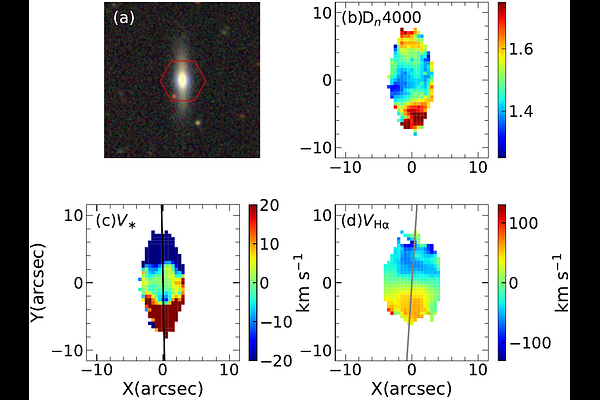
AbstractGas accretion process can fuel both star formation and black hole activity, playing a critical role in galaxy evolution. The counter-rotating structures are believed to originate from gas accretion, serving as an ideal laboratory for studying its impact on galaxy evolution. Based on the Mapping Nearby Galaxies at Apache Point Observatory (MaNGA) survey, we built a sample of 147 galaxies with counter-rotating stellar disks (CRDs). This is the largest CRD sample to date, accounting for $\sim$1.5% of the MaNGA survey. For a subset of 138 CRDs, global stellar mass ($M_\ast$) and star formation rate (SFR) were measured in reference. We constructed a control sample with similar $M_\ast$ and SFR but lacking counter-rotating structures. The CRDs relatively exhibit more bulge-dominated morphology, lower molecular gas mass fraction and reside in less dense environment, supporting the hypothesis that they primarily originate from gas accretion. We classified 96 out of 138 CRDs into four types based on their stellar and gas kinematics following the criteria from Bao et al. (2022). There are two additional CRD types: 8 CRDs show misalignment between both stellar disks and gas disk, indicating multiple gas accretion events with differing angular momentum directions; 34 CRDs lack ionized gas emission, showing the highest $M_\ast$ among all the CRD types, which may represent a final stage of CRD evolution. We compared the radial gradients of gas-phase metallicity and stellar population properties between CRD types, and found that the impact of gas accretion on galaxy evolution primarily depends on the abundance of pre-existing gas in progenitors.