Statistical Estimation and Correction of Model-Measurement Bias in Time-Dependent Correction Factors of KAGRA

Statistical Estimation and Correction of Model-Measurement Bias in Time-Dependent Correction Factors of KAGRA
Shingo Hido, Takahiro Yamamoto, Dan Chen, Takahiro Sawada, Shinji Miyoki
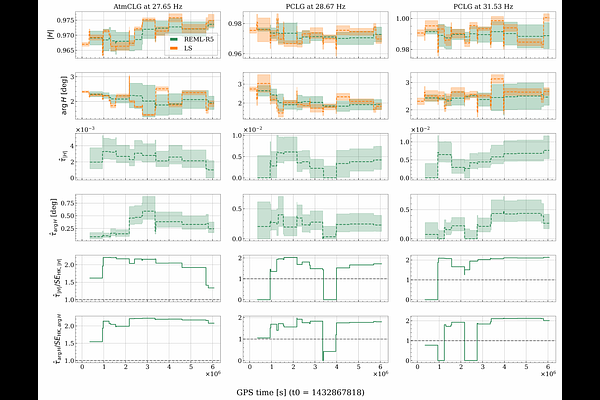
AbstractCalibration of gravitational-wave detectors reconstructs the strain h(t) from the detector output, and bias and uncertainty in this reconstruction directly affect downstream analyses. In ground-based interferometers, time-dependent correction factors (TDCFs) are estimated from calibration lines to track temporal variations of the detector response, while the underlying model parameters are periodically updated using broadband swept-sine calibration measurements (SSCMs). However, if a model-measurement bias exists between the measured transfer function and the reference model, the TDCFs inferred from calibration lines can introduce a systematic deviation into the reconstructed strain. We propose a statistical framework to estimate and correct this bias using repeated measurement-to-model ratios at the calibration-line frequencies. The bias correction factors are estimated with a rolling random-effects model based on restricted maximum likelihood (REML) and incorporated into the TDCF estimation, with their uncertainty propagated to the reconstructed response. Applying the method to KAGRA O4c data, we find that the uncorrected response shows deviations of up to approximately 7% in magnitude and 5 degrees in phase relative to the SSCM-based reference in representative examples. The correction reduces these deviations, with a modest increase in the propagated uncertainty due to the included correction-factor uncertainty. This framework provides a practical way to combine broadband reference models with calibration-line-based tracking when model-measurement bias is present.