Closing the Domain Gap in Biomedical Imaging by In-Context Control Samples

Closing the Domain Gap in Biomedical Imaging by In-Context Control Samples
Ana Sanchez-Fernandez, Thomas Pinetz, Werner Zellinger, Günter Klambauer
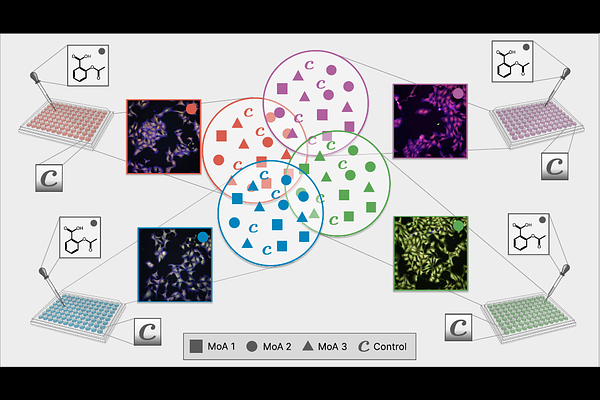
AbstractThe central problem in biomedical imaging are batch effects: systematic technical variations unrelated to the biological signal of interest. These batch effects critically undermine experimental reproducibility and are the primary cause of failure of deep learning systems on new experimental batches, preventing their practical use in the real world. Despite years of research, no method has succeeded in closing this performance gap for deep learning models. We propose Control-Stabilized Adaptive Risk Minimization via Batch Normalization (CS-ARM-BN), a meta-learning adaptation method that exploits negative control samples. Such unperturbed reference images are present in every experimental batch by design and serve as stable context for adaptation. We validate our novel method on Mechanism-of-Action (MoA) classification, a crucial task for drug discovery, on the large-scale JUMP-CP dataset. The accuracy of standard ResNets drops from 0.939 $\pm$ 0.005, on the training domain, to 0.862 $\pm$ 0.060 on data from new experimental batches. Foundation models, even after Typical Variation Normalization, fail to close this gap. We are the first to show that meta-learning approaches close the domain gap by achieving 0.935 $\pm$ 0.018. If the new experimental batches exhibit strong domain shifts, such as being generated in a different lab, meta-learning approaches can be stabilized with control samples, which are always available in biomedical experiments. Our work shows that batch effects in bioimaging data can be effectively neutralized through principled in-context adaptation, which also makes them practically usable and efficient.