Stellar separation shapes spin-orbit alignment in visual binaries

Stellar separation shapes spin-orbit alignment in visual binaries
Michael Poon, Dang Pham, Marta L. Bryan, Hanno Rein, Jiayin Dong
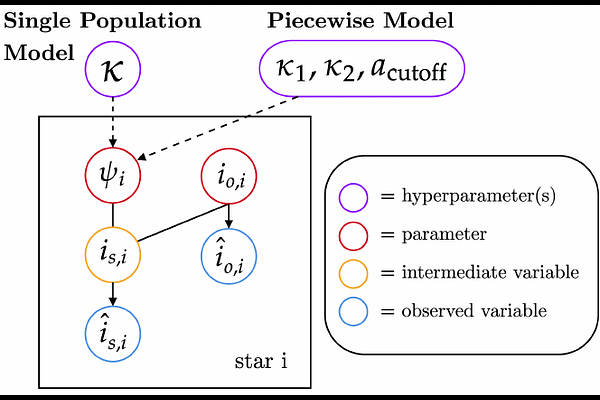
AbstractStellar binaries may form through several formation pathways, including disk or core fragmentation. Their spin-orbit angles are a signature of formation, although individual measurements for visual binaries are limited and broad. A seminal work by A. Hale (1994) found that visual binaries with separations $\lesssim 30$ AU tend to be more aligned, which laid the groundwork for binary formation theories. However, A. B. Justesen & S. Albrecht (2020) found that underestimated stellar radii lead to inaccurate spin-orbit angles and that KS statistics do not provide meaningful population-level constraints even with updated radii. Using a hierarchical Bayesian model to reanalyze their dataset, we find evidence with a Bayes factor of 12 for two subpopulations of spin-orbit angles separated by a $\sim 31-38$ AU cutoff. Binaries inside (outside) the cutoff are more (less) aligned, consistent with a Fisher distribution with $κ=48$ ($κ=6$). We also find possible indications of a secondary cutoff at $\sim 10-17$ AU, although more data is required to resolve this prediction. These cutoffs may mark transitions between formation pathways: closer-in binaries tend to form aligned in a shared protostellar disk, while wider binaries tend to form less aligned through turbulent fragmentation.