Natural Supercooling and Reheating along Supersymmetric Flat Directions and Observable Gravitational Waves at the Einstein Telescope and the Cosmic Explorer

Natural Supercooling and Reheating along Supersymmetric Flat Directions and Observable Gravitational Waves at the Einstein Telescope and the Cosmic Explorer
Jinzheng Li, Pran Nath
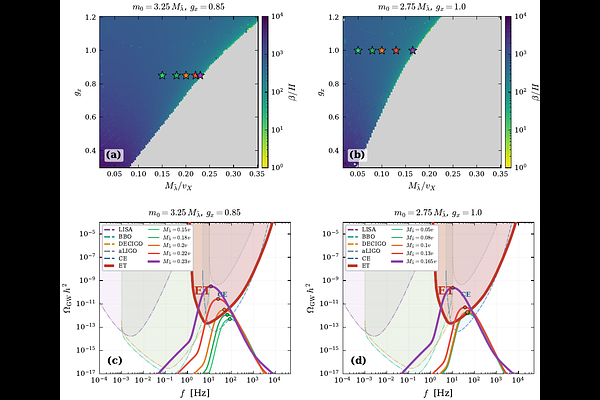
AbstractWe study supercooled first-order phase transitions in a supersymmetric hidden sector with a spontaneously broken $U(1)_X$, focusing on the frequency range of the Einstein Telescope and Cosmic Explorer. Along the D-flat direction the tree-level quartic vanishes, so the barrier is generated radiatively by soft SUSY-breaking splittings. In the $\overline{\rm DR}$ scheme the gaugino mass $M_{\tildeλ}$ sets the barrier depth, while the soft scalar mass $m_0$ stabilizes the broken vacuum. For $M_{\tildeλ}/v_X\simeq0.05$--$0.23$, the predicted signal reaches $Ω_{\rm GW}h^2\sim3\times10^{-10}$ near the percolation boundary. The observable amplitude depends sensitively on the portal coupling $δ$ through the hidden-to-visible temperature ratio at percolation: for a cold initial hidden sector the signal rises from the ET floor at $δ=10^{-6}$ to $Ω_{\rm GW}h^2\simeq7\times10^{-11}$ as the sectors approach thermal contact at $δ=10^{-4}$, while a hotter initial hidden sector gives a large signal already for weak portal coupling. We follow this evolution with an 11-variable Boltzmann system that separates the cold nucleating exterior from the reheated true-vacuum interior; reheating mainly enters through the energy budget and redshift factors. The same hidden sector can reproduce $Ω_{\rm CDM}h^2=0.12$ through relativistic dark-quark freeze-out followed by entropy dilution from hidden-Higgs decay, with $m_q\simeq30$--$800\;$keV and $N_{\rm eff}\lesssim{\rm few}\times10^{-5}$.